PROJECT
Industry: Solar powerProject overview
Objective
To ensure zero power export to the external grid while maintaining uninterrupted operation of an industrial facility through the integration of a solar power plant.
Additional objectives included:
- improving overall energy efficiency of the facility
- operating under balancing market conditions
- addressing strict constraints on equipment layout and installation
Challenge
Renewable energy projects, particularly solar power plants, are characterized by complex economic behavior driven by:
- variability of generation due to time-of-day and weather conditions
- dependency of electricity costs on tariff structures and balancing market mechanisms
Project Features
-
Operation of the solar power plant under highly variable load conditions
-
Client requirements:
- zero power export to the external grid
- minimization of electricity import from the grid
-
Constraints:
- strict limitations on available installation area
- limited project budget
-
Operating conditions:
- high ambient temperatures affecting equipment performance
- presence of harmonic distortion caused by inverter-based generation
Risks
-
dependency on an unstable external grid, including:
- exposure to high electricity tariffs during peak demand periods
-
lack of a reliable methodology for matching generation and load profiles, resulting in:
- oversizing of PV capacity
- excessive energy storage capacity
- inefficient capital allocation
- deterioration of LCOE/LACE indicators (based on U.S. Energy Information Administration methodology)
Approach
A comprehensive digital model was developed to identify the optimal solution, integrating:
- the solar power plant
- the facility’s electrical power system
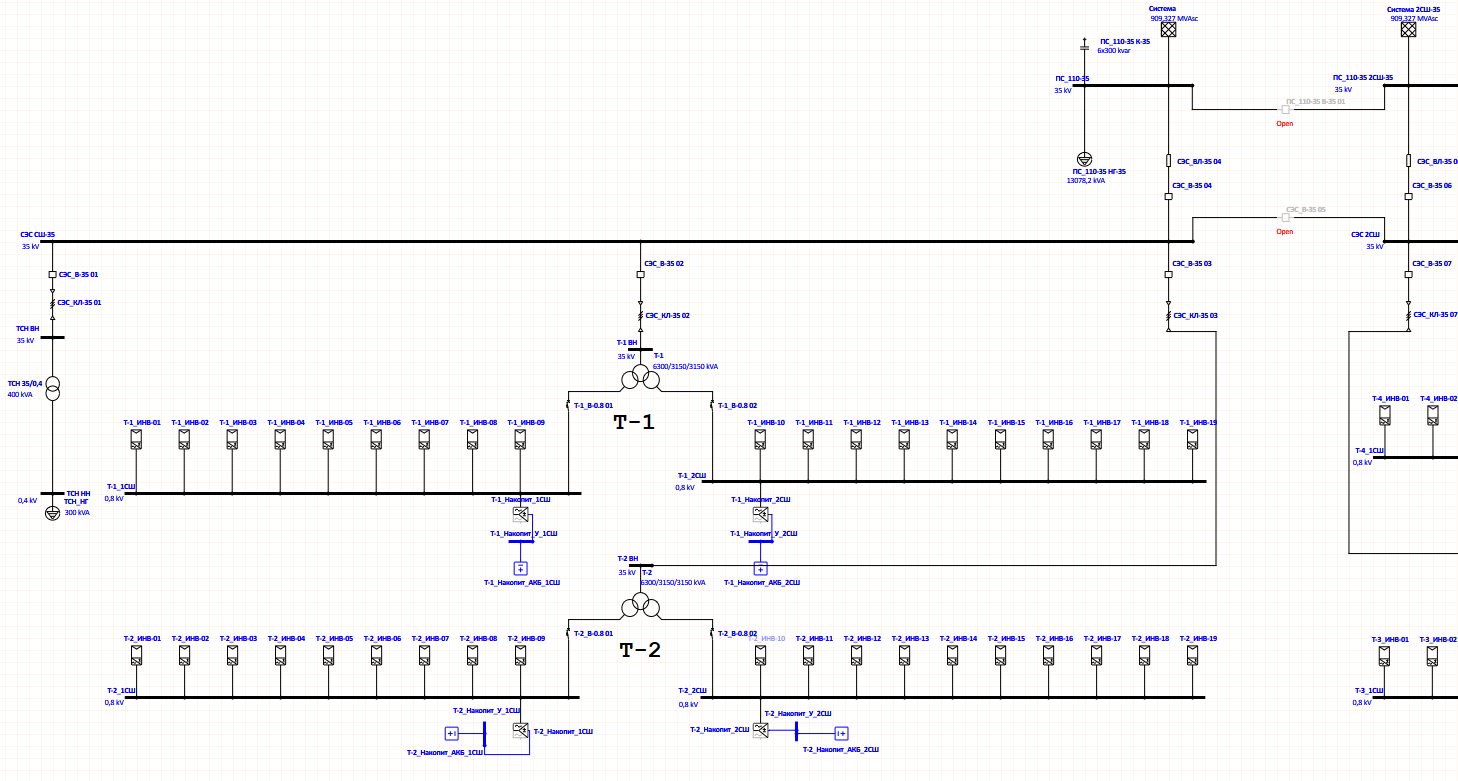
The following scope of work was performed:
- collection and validation of input data, including site visits
- selection of photovoltaic modules and inverters considering layout constraints
- development of a detailed power system model
- calculation of required installed PV capacity
- load flow studies for various weather conditions and times of day
- sizing of energy storage systems (BESS)
- simulation of battery charge and discharge cycles
- short-circuit current calculations
- harmonic analysis
- selection of power distribution equipment
- technical support during procurement and vendor selection
Analysis
A detailed model of both the solar power plant and the facility’s electrical system was developed, including the external grid connection up to the 110/35 kV switchyard.
Conservative operating scenarios were considered:
- all possible operating conditions of the facility, including peak daily load profiles
- reduced PV generation due to adverse weather conditions (cloud cover, precipitation)
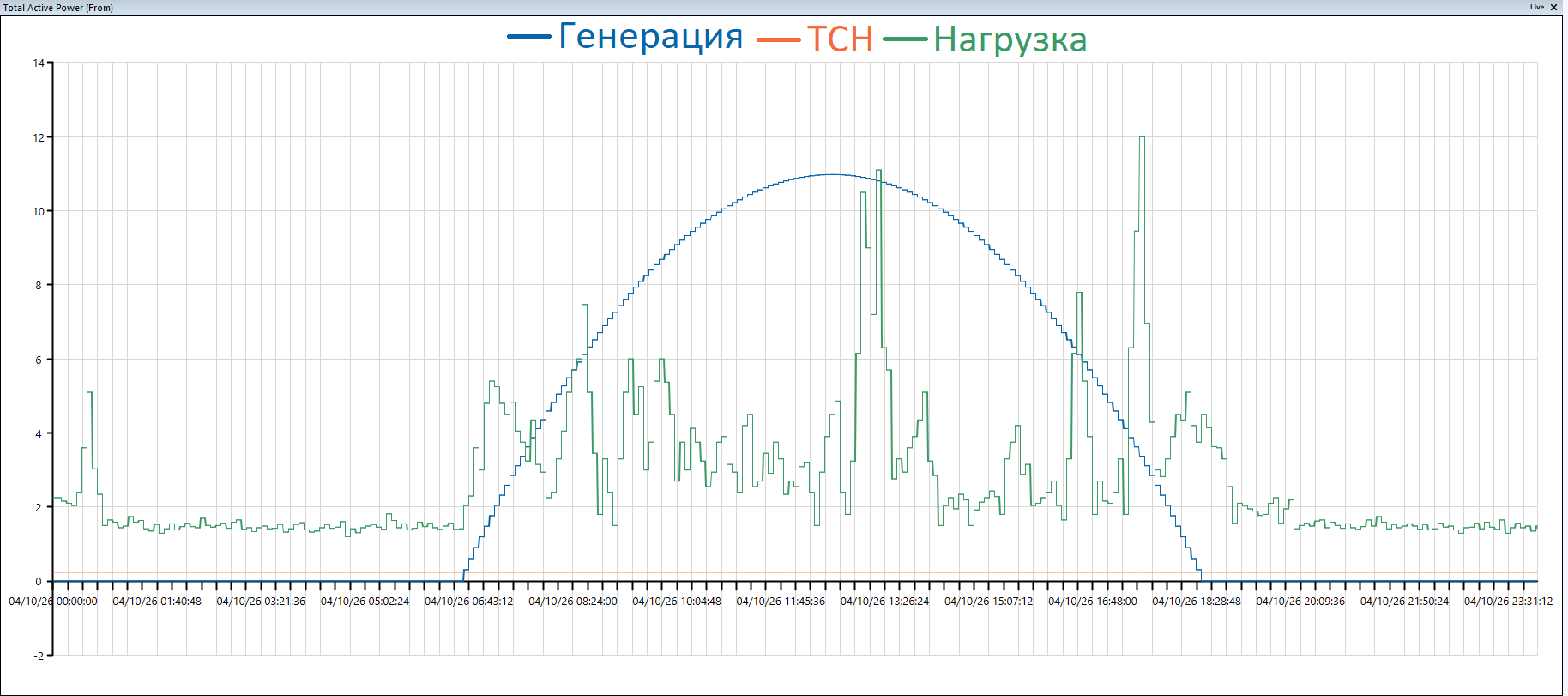
Generation profiles (based on actual regional solar irradiation data) were matched against load profiles to determine:
- optimal installed capacity of PV modules
- inverter configuration
- economically efficient operating strategy
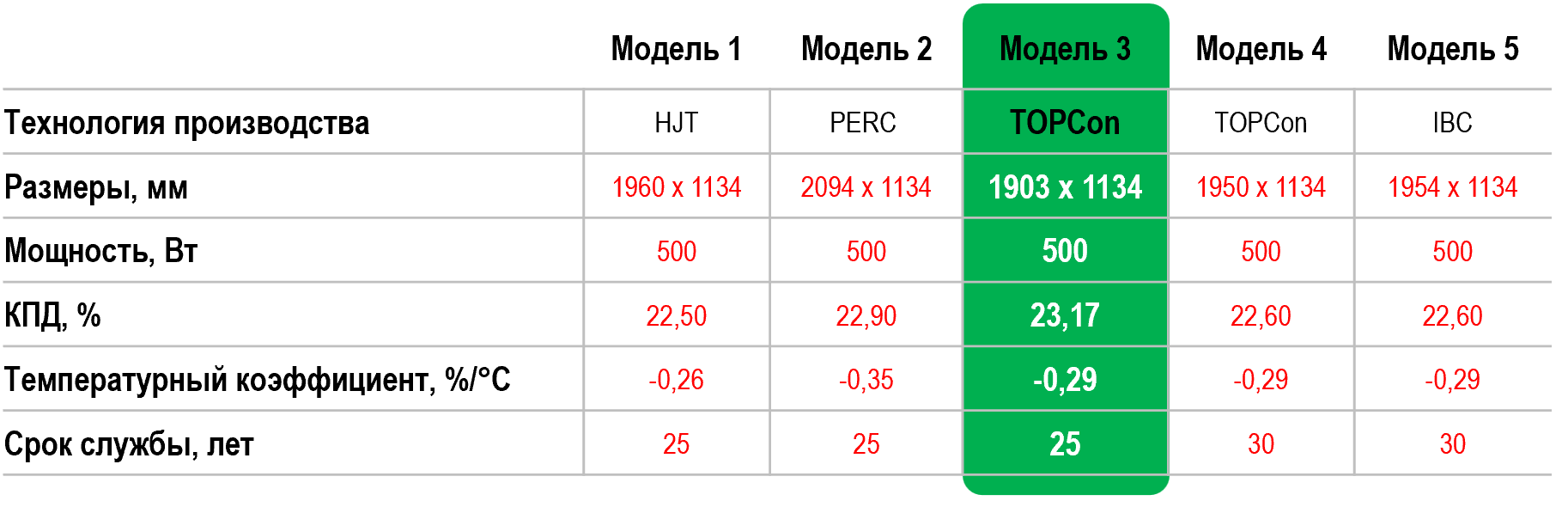
The selection of photovoltaic modules considered:
- technology type (monocrystalline, polycrystalline, thin-film)
- physical dimensions
- temperature performance
- cost of different solutions
Based on the required capacity and available site area, the most efficient configuration of PV modules and inverters was selected.
Inverter selection was driven by spatial constraints for substations and switchgear, leading to the adoption of solutions with 0.8 kV output voltage.
To minimize footprint, transformers with split low-voltage windings were selected.
The increased cost of non-standard equipment was offset by reduced capital expenditures on civil works due to smaller substation dimensions.
All calculated parameters were verified against applicable standards:
- GOST R 70787-2023 — Technical requirements for photovoltaic power plants
- GOST 32144-2013 — Power quality standards
- IEC/TR 61000-3-6 — Electromagnetic compatibility (harmonic emission limits)
- IEC 63409-3:2025 — Testing of power conversion equipment
- ShNK 2.04.15-23 — Photovoltaic stations
Results
The following results were achieved:
-
full compliance with the key requirement of zero power export to the external grid
-
stable and predictable operation of the facility under variable generation conditions
-
determination of optimal installed capacity of PV modules and inverters based on:
- generation profiles
- load profiles
- site constraints
-
selection of PV modules with low temperature coefficients, ensuring minimal performance losses in high-temperature conditions
-
implementation of transformers with split windings, resulting in:
- reduced capital expenditures
- smaller substation footprint
- reduction in high-voltage equipment, protection systems, and cabling
-
replacement of existing capacitor banks at the 110/35 kV substation with reactor-based solutions, enabling:
- mitigation of harmonic distortion from inverters
- elimination of false protection trips
-
determination of optimal energy storage capacity based on generation-load matching, ensuring:
- zero power exchange with the grid
- minimized capital investment
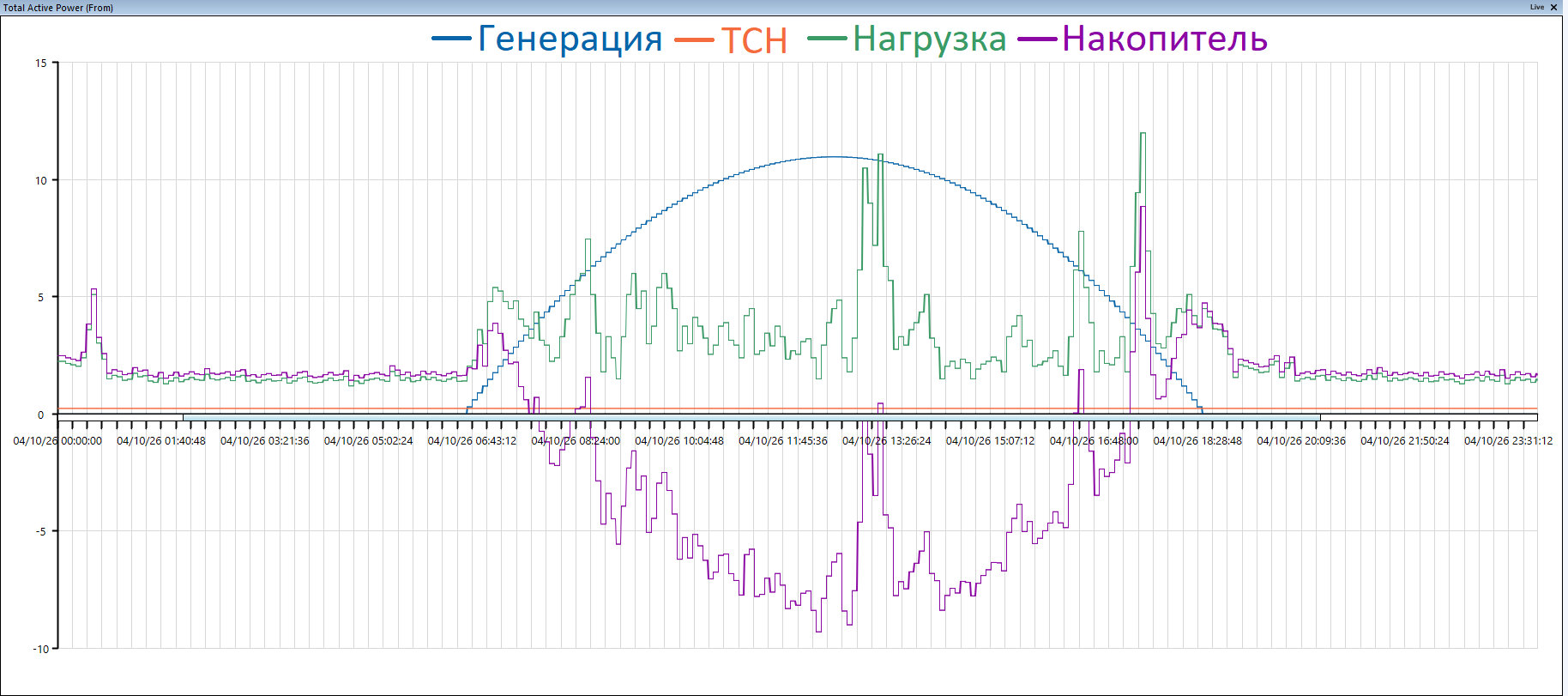
- reduction in electricity consumption from the grid and corresponding decrease in unit production costs